
Lorem ipsum dolor sit amet consectetur. Eget porta aliquet sed egestas diam
Read more

IFS Capital


.svg)


For buyers, Supply Chain Financing (SCF) is a working-capital lever—not simply a supplier-support programme. Used well, it can extend or standardise payment terms, preserve cash, reduce ad hoc early-payment requests and create a disciplined route to supplier discounts.
The buyer keeps its agreed payment date. Suppliers that need cash earlier may be paid against approved invoices using a credit limit established for the buyer by a bank or financier. When the buyer has surplus cash, it can instead offer early payment directly in return for a clearly priced trade discount.
This guide explains how Supply Chain Financing works, what it means for buyers and suppliers, and why it can be relevant to businesses across ASEAN.
Small and mid-sized suppliers can feel the impact of long payment terms particularly strongly — more so in times of local and global economic flux. Some may have limited access to traditional financing, either due to collateral requirements, limited operating history, or other credit-assessment considerations.
The result can be a cash-flow gap that holds back an otherwise healthy business. Growth may stall not because there is a lack of demand or orders, but because cash is tied up in unpaid invoices.
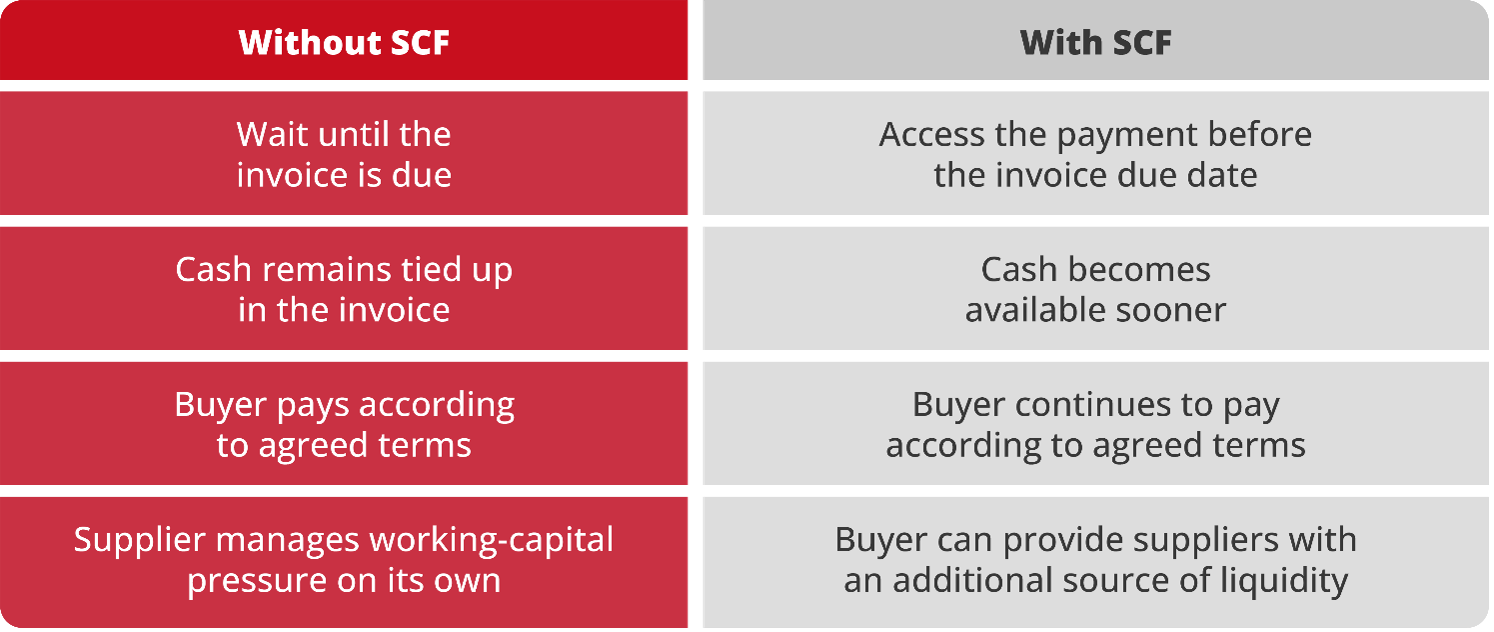
Supply Chain Financing can help address this gap by giving eligible suppliers the option to access cash earlier against buyer-approved invoices.
In a typical buyer-led Supply Chain Financing arrangement, a financier pays a supplier early for an invoice that the buyer has already approved. The buyer then settles the invoice at its normal due date.
For example, if a buyer approves an invoice with a 90-day payment term, the supplier may choose to receive payment earlier rather than wait the full 90 days. The exact advance amount, financing cost and eligibility depend on the specific programme and credit approval.
The key element is the buyer-approved invoice. Once the buyer confirms that an invoice is valid and due for payment, it may become eligible for early payment under the SCF programme.
Because the financing can be based substantially on the buyer's approved obligation and credit profile, rather than relying solely on the supplier's own balance sheet or collateral, SCF may provide an alternative for suppliers that find conventional financing more difficult to access. However, eligibility and collateral requirements vary by programme and credit assessment.
A few industry terms to be aware of:
In a typical IFS Capital Supply Chain Financing (SCF) programme, the process works as follows:
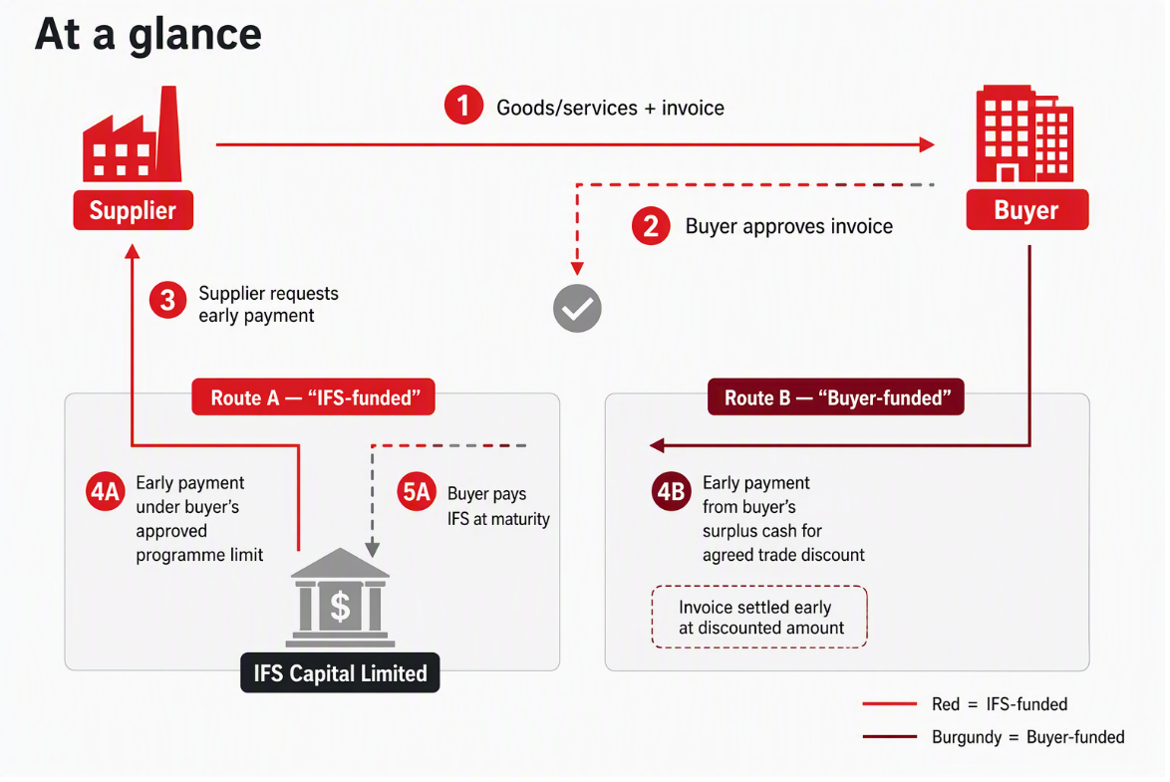
Say a supplier delivers S$100,000 of goods to a large buyer on 90-day terms.
Without SCF: The supplier waits the full 90 days for the S$100,000, while funding wages, restocking and other operating expenses in the meantime.
With SCF: After the buyer approves the invoice, the supplier chooses to sell it for early payment. The supplier might receive, for example, S99,000shortlyafterapprovalratherthanwaiting90daysforthefullS100,000. At maturity, the buyer pays the S$100,000 to IFS.
Buyer impact: the S$100,000 cash outflow remains on day 90, while the supplier receives near-term liquidity from IFS. The buyer can therefore support the supplier without shortening its own payment cycle.
Alternative buyer-funded outcome: if the buyer has surplus cash, it may offer an earlier settlement date for a lower payment amount. The discount, accelerated days and cash deployed are recorded through the same controlled process, allowing treasury to calculate the return and compare it with other short-term uses of cash. If neither option is selected, the invoice follows the normal payment process.
Note: The above figures are illustrative only. The advance amount, financing cost, eligibility and payment timing depend on the specific arrangement and applicable credit approval.
Supply Chain Financing can provide benefits to both sides of a buyer-supplier relationship, although the exact benefits depend on the programme structure.
Both Supply Chain Financing and factoring can give suppliers earlier access to cash, but they typically work differently.
The two solutions have different structures and may suit different business requirements. The right option depends on factors such as the nature of the receivables, the buyer-supplier relationship, financing requirements and the applicable provider's terms and credit criteria.
ASEAN is a major trading region, with businesses operating across increasingly interconnected domestic and cross-border supply chains.
In 2024, ASEAN's trade in goods reached US3.8trillion,up8.9%fromthepreviousyear,whiletradeinservicesreachedUS1.3 trillion, up 12.2%. ASEAN also attracted US$226 billion in foreign direct investment (FDI) in 2024, an increase of 8.5%. These figures highlight the scale of commercial activity moving through the region's businesses and supply chains.
Small and mid-sized businesses are an important part of this ecosystem. The ASEAN Secretariat estimates that there are around 70 million MSMEs across ASEAN, accounting for over 97% of establishments across ASEAN Member States. The Secretariat's regional figures also indicate that MSMEs contribute around 85% of employment, 44.8% of GDP and 18% of national exports.
These businesses are therefore an important part of the region's supply chains, but they can also be more exposed to working-capital pressure when customers take longer to pay.
For a supplier operating on extended payment terms, having to wait for an invoice to mature can tie up cash that could otherwise be used for inventory, payroll, new orders or business expansion.
Supply Chain Financing can help address this working-capital challenge by giving eligible suppliers the option to access cash earlier against buyer-approved invoices, while buyers can maintain their agreed payment terms.
The relevance of this is particularly clear in a region where businesses increasingly operate across borders and supply chains. For suppliers, earlier access to cash can help make long receivables cycles more manageable. For buyers, an SCF programme can provide a way to support important suppliers while continuing to manage their own working-capital requirements.
As a specialist financing institution with almost four decades of experience serving businesses across Southeast Asia, IFS Capital has a regional presence spanning Singapore, Thailand, Malaysia and Indonesia. The company also extends more than S$1 billion annually to SMEs, helping businesses access working capital across the region.
For Supply Chain Financing specifically, IFS Capital’s solution is a financing method initiated by an anchor buyer to help suppliers finance approved invoices that may otherwise be more difficult to finance under normal lending criteria. Suppliers can draw financing when required against approved invoices, subject to the applicable programme and credit terms.
This regional SME focus is relevant to the SCF model. Smaller suppliers may find it harder to obtain conventional working-capital facilities, while a buyer-led SCF programme can provide another route to financing based on eligible buyer-approved invoices. IFS Capital's SCF is designed to help suppliers access financing based on the credit standing of their buyers.
For businesses trading across ASEAN, IFS Capital's presence in four markets can also provide a regional perspective when considering financing requirements. Where local-currency financing is available, it may reduce the need for currency conversion for certain transactions.
However, FX exposure and hedging requirements depend on the currencies involved, underlying cash flows and the specific financing arrangement, so local-currency financing should not be presented as eliminating the need for FX hedging in every case.
The aim is to provide a financing arrangement that works for both sides of the invoice: helping eligible suppliers access cash earlier while enabling buyers to maintain agreed payment cycles and manage working capital.
Not necessarily. In a typical SCF arrangement, a financier provides early payment against eligible buyer-approved invoices. The exact legal and financing structure varies by programme and provider.
The financing cost depends on the specific programme and arrangement. In many structures, the supplier pays a financing cost when choosing to receive an invoice early. Other arrangements may allocate costs differently.
Not always. Some SCF programmes may allow financing based primarily on buyer-approved invoices and the relevant credit assessment, potentially without additional collateral from the supplier. Requirements vary by programme, provider and credit approval.
No. SCF programmes can involve large buyers and their small or mid-sized suppliers. Eligibility depends on the programme structure, participating businesses and applicable credit criteria.
SCF is typically buyer-led and centres on buyer-approved invoices, while factoring is generally supplier-led and focuses on financing or selling a supplier's receivables. Both can provide suppliers with earlier access to cash, but their structures and suitability can differ.
It can be used in certain cross-border trade arrangements, subject to the programme structure, participating markets, currencies, regulatory requirements and credit approval.
Not necessarily. Local-currency financing can reduce the need for currency conversion in some transactions, but whether FX hedging is appropriate depends on the currencies involved, the underlying cash flows and the business's individual exposure.
If your business is dealing with long payment cycles, tied-up receivables or pressure to balance supplier relationships with working-capital requirements, Supply Chain Financing may be worth exploring.
Speak with our team to find out whether Supply Chain Financing works for your buyer-supplier arrangements and payment terms.
IFS Capital Limited, established in 1987, is a trusted Singapore-based financial institution. Specializing in tailored financial solutions for Micro, Small & Medium Enterprises (MSMEs), IFS Capital offers factoring, invoice financing, and various loans to support business growth. Rely on our expertise for your financial needs.


